Welcome to the second stop on the time travelling Silver Express on an exhilarating journey through Egyptian history and culture with Laila Rifaat, author of the Aliya series. Make sure you read the fascinating letter from Aliya to her Geddo (grandfather) describing Egyptian clothing and fashions. Visit the other blogs on the tour for more letters and insights into life in Ancient Egypt.
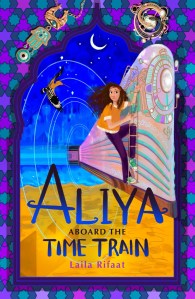
The spectacular sequel to Middle Eastern-inspired fantasy Aliya to the Infinite City.
“When sinister magic threatens Aliya’s world once more, she is sent away on a school trip for her own safety aboard the time-travelling Silver Express. But what is supposed to be an educational journey through Egyptian history becomes a deadly race to save it from evil time-twister and master of disguise, Dorian Darke.”
Letter 2 – Dress like an Egyptian (Ancient Egyptian clothing)
Dear Geddo,
It’s our second day on board the Silver Express. We’ve finally arrived in Ancient Egypt! (I’m actually somewhere between 2030 – 1640 BCE right now. Imagine!). After breakfast we went to the outfitting coach to get dressed up for a visit to the Middle Kingdom. The Silver Express has a whole coach devoted to time-appropriate clothes. You should see it! Stacks and shelves packed full of everything from Ancient Egyptian headdresses and wigs, to Mamluk armour, to Ottoman turbans. The possibilities are endless! The purpose of us dressing up is, of course, to fit into the times we visit, to avoid freaking anyone out at the sight of our modern clothing. Still, all me and my travel-pod wanted to do when we came in here this morning was to play dress up. We made Soliman, our genie guide, so nervous that his head vanished (You know how genies go invisible when they’re stressed.)
At breakfast, Soliman gave us a run through of the basic wardrobes that existed at the time. He even got the genie coach attendants to model the outfits and walk down the corridor between the tables, like down a runway. We learnt that men wore loincloths, kilts, sashes, and shawls. Then, depending on their roles in society, they could wear accessories such as hats and carry walking sticks. Murad, our coach attendant, came in wearing a royal blue crown adorned with a golden cobra – a khepresh, that made him look very fancy indeed.
Soliman asked some of the ladies in our party to model the women’s clothes and Arsinoe, that pretty student from the Hippolytas hostel, jumped at the opportunity to show off. She looked fantastic in all the outfits, in all the wrap-around cloth and stitched dresses, sashes, wraps, and cloaks. Because cloth was expensive, a sign of wealth was to wear a lot of it. So while rich ladies wore ankle-long dresses with many wraps, servants could only afford short skirts.
Soliman gave me and the other children quite a shock when he described what children used to wear: nothing at all! (No one modelled that fashion, thank God!) Well, at least that was the case until they were 6. I guess that had to do with the hot climate, and maybe because clothes were costly. Another shocking fact was that children mostly wore their heads shaved! Well, they did get to keep a lock of hair on the side of their head called ‘the sidelock of youth.’ That was shaved off as a sign that they were becoming grown-ups.
Thankfully, all of us children got linen garments to wear. Almost all the clothes are made of flax, or linen, which apparently is really hard to dye, so the ancients mainly used the fabric in its original colour which I think looks nice and clean. It’s light too. The linen dress Soliman gave me to try on swishes airily around my legs when I move. It makes sense too, to wear a fabric like this in our hot, Egyptian climate.
Colour was a way of showing your how important you were, because dyed cloth was expensive. But because linen was so hard to dye, they usually attached coloured bands to the hems of their dresses. The most common colours were red, blue, and sometimes yellow. Footwear, like sandals, were also expensive, and not worn by everyone. It’s hard to imagine not having any shoes. Imagine going to school barefoot.
The ancients really knew how to make the most out of basics. Most garments are just a square or rectangular pieces of cloth that they wrap around their body in different ways. Turns out though that the plain dress is a backdrop for something the ancients really loved: to accessorise. Not just women wore jewellery back then. Men, too, wore accessories made from precious metals, semi-precious stones, and glass beads. The poor, who couldn’t afford all that would wear beads made of painted clay, animal teeth, bones, or shells.
The ancient Egyptians would probably have approved of our online skin care trends, because they were really into beautifying themselves. Both men and women wore eye make-up, but not just for beauty. It apparently had a symbolic and religious significance too. For the eyes they used kohl – a black or green powder that was mixed to a paste and applied with a stick around the eyes – like our modern eyeliner. The paste also had antibacterial properties and protected the eyes from the harsh glare of the sun. Lipstick was made by mixing ochre (a natural clay pigment) with oils. Sometimes they even mixed in squashed beetles! Soliman gave us some to try, which made Charlotte, our Victorian chaperone, screech in horror. She was already upset about the lack of corsets in the Ancient Egyptian wardrobe. Charlotte might have disapproved of the ancients, but I think their clothing was comfortable, if a little skimpy at times.
As for their beauty routines, they feel quite ‘timeless,’ like treatments we could get offered at a fancy spa. Soliman told us that they used to exfoliate their skin with Dead Sea salts, coffee scrubs, and milk baths. They rubbed their skin with almond or castor oil, and used wax made of sugar, lemon, and water to remove body hair. That’s the same recipe for halawa that ladies still use back home in Cairo! They also used mirrors made of polished bronze, tweezers, and razors.
Both men and women were also big on wigs: Sometimes they wore a cone made of fat infused with perfume on top (like the one Charlotte was offered at dinner the other night). When the fat melted, the perfume soaked into the wig, making it smell great. Imagine walking around with a cone of fat on your head, like some Ancient Egyptian unicorn!
As I write, I’m watching my friends getting fitted for their flesh-coloured rubber-caps. The genie attendant is pulling them over their heads to make them look shaved. Soliman is insisting we wear them to look authentic. And now…Victoria is throwing a fit. It always takes her ages to arrange her Victorian hairstyle in the mornings. I better go and calm her down. I’ll write more tomorrow.
Your granddaughter,
Aliya
PS. A fun fact I learnt is that the men were responsible for doing most of the laundry. That’s because washing clothes in the river was dangerous. There could be crocodiles lurking in the rushes!
Useful links
Egyptian fashion: https://rawi-publishing.com/articles/slow_fashion
Children’s clothing https://www.archaeologynow.org/egypt-blog/blog-post-title-two-hz67c#:~:text=In%20ancient%20Egypt%2C%20if%20you,bracelets%2C%20necklaces%2C%20or%20earrings.
Jewellery:
Headdresses:
https://study.com/academy/lesson/video/egyptian-headdress-history-meaning-facts.html
https://www.metmuseum.org/art/collection/search/544477
Beauty routines:
https://edition.cnn.com/style/article/ancient-egypt-beauty-ritual-artsy/index.html
Absolutely fascinating! I learnt a lot of new facts just from reading that one letter so I know that young historians are going to love reading more about Aliya’s adventures in the books available so far. Full of excitement, mystery and a pinch of peril!
Jo.
*Many thanks to Chicken House Books for inviting me to be a part of this blog tour*

 Library Girl and Book Boy