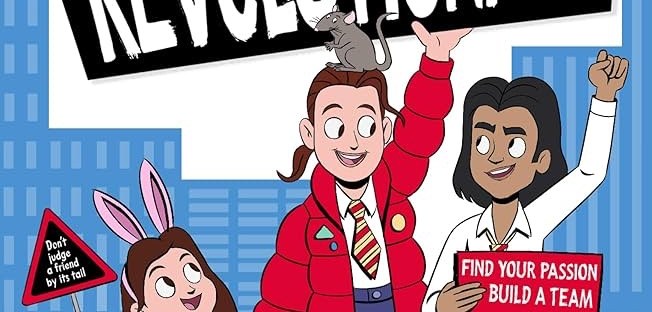
Introducing ‘How to be a Revolutionary,’ a great introduction to the world of politics for middle grade readers wrapped up in a compelling story of blended families, fighting for a cause, and hope. Be sure to read Lucy’s exclusive piece about why she decided to write this wonderful book!
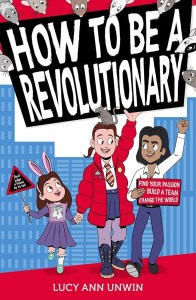
“What do you all come here for?’ ‘Why, to change the world, of course! Don’t we all want to change the world . . . if we can?’
A General Election is coming and the Revolutionaries are gathering at Natalie’s house. She’s determined to be a part of it all, but is it really just about red coats, muddy boots and piles of glossy leaflets? Surely changing the world should be more exciting than that?
It’s time to start her OWN revolution – and it all begins with her pet rat . . .”
‘Why I Wrote How To Be A Revolutionary’ by Lucy Ann Unwin
Quite simply, I started writing How To Be A Revolutionary because I was frustrated, and, if I’m honest, full of an overwhelming and depressing sense of powerlessness.
I can remember the exact moment I wrote the title into an empty document, because it was the morning after the 2019 general election. Boris Johnson had swept to a victory I hadn’t believed possible and I felt like I’d spent the past five years fighting and losing, and fighting and losing again. I was feeling pretty hopeless about the next five years too.
It felt natural to turn to kids — not only because writing is where I retreat to when I need peace, but children understand all too well how it feels to have no control over what happens to them, and certainly no political power. What took me by surprise writing How To Be A Revolutionary, was remembering the many ways children do actually have power, and how huge their influence can be. They can be responsible for such meaningful change, just through taking small actions within their immediate circles.
The more I wrote about Natalie’s own campaign to change the world, and the more her character let me access a child’s natural instinct towards kindness, the more optimistic I felt about the future in general. The process of exploring her story gave me back my own hope, which grew and grew as I got deeper into the book.
In Natalie, I had a character I believed could do more good than I had managed in months of fruitless campaigning, but the campaigning itself had also given me a perfect setting: the residential home used as a temporary campaign HQ. The house I’d been stomping in and out of for the past few weeks had had paper signs blu-tacked around to tell us where to find tea, or the loo, and those signs found their way into the book. In the bathroom was a toddler’s toilet seat and set of steps — it was imagining what the houses’ invisible children made of all the chaos consuming their home that gave me the basis for the plot. (That election also gave me a timeline — hopefully for young readers the story is timeless, but adult readers may recognise the dates of the particular election that sparked the story.)
Of course, as I wrote, other motivations took over, as they always do. Natalie wanted to be like her Dad’s friends and “change the world”, but the changes she really needed to accept were happening at home. I always find that the more I get to know my characters, the more it comes back to family and friendships. So Natalie’s flawed attempts to navigate her parents’ separation and her newly blended family, as well as her protective and beautiful relationship with her little sister, Lily, became the true heart of the book. She also learnt to reach out to a team of great friends that made her campaigning all the more worthwhile.
I still feel politically frustrated, but not nearly so hopeless. Who knows what the next five years hold, but with the Natalie, Lily, Avinash, Analise and Percys of this world all doing their bit, I’m sure we’ll be just fine.
I think Lucy’s right; we really do need to hope that future generations learn from the mistakes of their parents and grandparents, and go on to right some of those wrongs. Hopefully stories like hers will help children realise that everyone has the power to influence people and make a meaningful change.
You might also like to read one of Lucy’s other books: The Octopus, Dadu and Me.
Jo.
*Many thanks to Uclan Publishing for inviting me to be a part of this blog tour*
 Library Girl and Book Boy