
If you are looking for a story which is part Wind in the Willows and part Sherlock Holmes, look no further than this fiendish mystery from the wonderfully-named Charlie Nutbrown. Be sure to read Charlie’s special piece about why he loves animal stories.
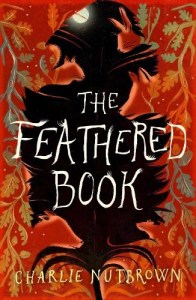
“Monty the fox has a dream – but that’s nothing new. Monty is brilliantly clever. But to the despair of his best friend, Nettle the rabbit, he just can’t stick at anything. He’s tried being an inventor, an aeronaut, and a magician; he’s had a go at painting, writing, and exploring – and got bored of them all.
Now Monty is determined to be a detective. Despite the danger, he decides to solve the mystery of The Feathered Book. This priceless work of alchemy has disappeared in baffling circumstances – stolen from a locked and empty room in an underground library known as the labyrinth. What’s more, the work is no ordinary book, for it is reputed to be cursed: many creatures have tried to steal it over the centuries, and all have perished in the attempt.
Leaving his own cosy home in the roots of an old oak tree, Monty sets off to investigate. Dragging cynical Nettle with him, he heads to the ginormous, red-leafed tree that houses the library. But as they sail across the Lake – a huge body of water dotted with wooded islands – they are swept up in a dangerous adventure, featuring pirates, mazes, boobytraps, kidnaps, boat chases and knife fights. Along the way, they meet the motley cast of characters who live on the Lake, from a rakish pirate otter to a kindly police badger, from a sinister and wealthy toad to a meek hedgehog astronomer.
But who stole The Feathered Book? Will Monty the fox manage to catch the thief? And how was the impossible crime committed in the first place?”
WHY I LOVE ANIMAL STORIES
I was Moomintroll, making paper boats and exploring caves. I was Moley, drifting down a sunlit river. I was a brave young mouse saving Redwall Abbey, yet again, from marauding villains – before enjoying a slice of damson pudding and a bowl of meadowcream.
I have always loved animal stories. I read them as a child. I read them as a teenager. And I read them now – when I’m not busy writing them. My new novel, The Feathered Book, is set in a world of talking animals, with a cast of fox detectives, otter pirates, raven alchemists, and squirrel librarians. A locked-room mystery, it sees Monty the Fox and Nettle the Rabbit attempt to solve a seemingly impossible crime: the theft of a cursed work of alchemy from a labyrinth beneath a library. But as they cross the Lake (an archipelago of small, wooded islands), they are plunged into a rollicking adventure, facing booby traps and kidnappings, labyrinths and swamps – not to mention a terrifying collection of burglars, corsairs and master criminals.
That I would write such a story was probably inevitable, given how many of my favourite childhood books featured talking animals. I have no doubt the influence of Alice’s Adventures in Wonderland, The Wind in the Willows, Winnie-the-Pooh, The Deptford Mice, The Mouse and His Child, and the Redwall series (to name a few) are all over The Feathered Book.
But I didn’t write a talking animal story simply out of nostalgia. For in shunning humans and writing of animals, an author has enormous advantages. Freed from the rules of human society, a writer can simply ignore tedious topics like money, jobs, and parents. You can be vague about age, and background, and education. You can make all the characters distinctive and stand out from each other. You can avoid dreary description of the characters’ appearances – a bugbear of mine. (You simply have to state that a character is, say, a mouse in a top hat, and the reader conjures the character for you.)
Additionally, the tradition of animal stories is so firmly established, you can play with the expectations and conventions. Are rats always villainous? Owls wise? Hedgehogs harmless? This, of course, is particularly useful in a detective novel like The Feathered Book, where manipulating assumptions about the characters is all part of the game.
Above all, though, animal stories provide the writer (and the reader) with freedom. An animal story immediately removes you from this country, this world, this reality. You may be somewhere, but you’re not here. There are rules, but they are not ours. This was a quality I loved as a child, playing Moomintroll, Ratty, and Martin the Warrior. And I love it now, writing The Feathered Book. For animal stories, far from being silly or trivial, fulfil our desire for freedom, for imagination, and for adventure.
And, come to think of it, there is nothing more human than that.
I love an animal series too. Whether it was The Animals of Farthing Wood when I was growing up or, more recently, The Legend of Podkin One Ear, animal stories have always caught my attention.
I am sure that readers will identify parts of their own characters in the host of creatures in Nutbrown’s tale and will have almost as much fun as Monty trying to work out just how the feathered book came to go missing.
Jo.
 Library Girl and Book Boy