When I read that Tania Unsworth was inspired to write this by the hidden, forgotten corners that no one ever noticed, I was intrigued. As a child, I spent a lot of time imagining what it would be like to set up camp in a secluded spot and live there. Luckily, I never had to find out, but I had everything planned!
The characters in ‘Nowhere Island’ are not so lucky. They all ended up where they were due to very difficult, and varied, family circumstances: escaping physical abuse, facing social isolation, or a string of unsuccessful foster placements. Each of them searching for something they could belong to and feel a part of. Make sure to read Tania’s piece which explores how dark is too dark in children’s literature.
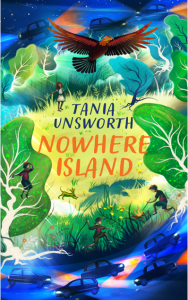
“Hidden at the intersection of several busy highways behind the trees and scrubby undergrowth is an island, full of secrets…
Pez has lived there for a while now, enjoying the solitude. She has a vegetable patch, a routine, her own way of doing things and a condor, who may be outstaying his welcome.
Runaway brothers, Riley and Grayson call the island home too. They keep their distance from Pez and spend precarious days trying to survive, still relying on the man-made world which speeds around them.
Then Gil arrives, with his hagstone and a dream of happy families, and everything changes. The four of them find a way of living and believe they might stay on the island forever. But all too soon they witness something they should never have seen and they’re in deadly danger…”
How dark is too dark? Dealing with adult themes in children’s fiction
By Tania Unsworth
The line between ‘kid-friendly’ and ‘utterly unsuitable’ ought to be obvious for an author of children’s books. But for a writer like me, it can be surprisingly difficult to spot. I’m the opposite of a moth in that way, forever drawn to the dark. And when I started work on Nowhere Island, I knew it was going to be even trickier than usual to get the balance right for two main reasons. First, I wanted to set the book in the real world, a place where it’s hard to get away with the sort of sinister events that are perfectly acceptable in fantasy. Second, I knew I had to deal with adult themes in the book, because they were vital to the story. My protagonists are four children who have run away from home, and I had to give them compelling reasons for doing so.
Finding the right way was a struggle. I started the book three times, and each time I got to page forty or fifty I had to stop, a little appalled by how disturbing the story was becoming.My four characters have all – in different ways – been utterly let down by the adults in their lives. Gil is an orphan, rejected by one foster home after another. Brothers Riley and Grayson have fled a violent father, and Pez has escaped from a disturbing and possibly dangerous cult. I couldn’t tone down the extreme nature of these home situations because to make the story work, it had to be clear that there was no turning back for these children. That they were utterly alone in the world. But my early drafts of the book felt less like an adventure story for kids and more like a collection of casefiles from the department of social services.
The solution finally came to me on my fourth attempt. It sounds pretty simple, but at the time it felt like an epiphany. Instead of conveying these dark, adult themes through the lens of an adult as I’d been doing, I decided to present them entirely from a child’s point of view, in language that a child would use. That’s why there is no mention of the word ‘cult’ in the book, or ‘child abuse’ or even ‘trauma’. By letting the children speak for themselves, I was able (I hope!) to avoid dwelling on their experiences in an upsetting and inappropriate way, because children themselves don’t dwell on such things. On the contrary, having known no different, they are often heartbreakingly matter of fact about their own suffering. Riley and Grayson don’t speculate on why their father hit them, for example. They simply assume he was “angry”. And Gil doesn’t see himself as the victim of a cruelly imperfect system. His unhappiness simply intensifies his longing to find a place he can call home.
In addition, I was careful to present the most disturbing events of the book in retrospect. By the time we encounter these children, they are already in a place of (relative) safety – another way of mitigating the trauma of their experiences…
Some topics don’t belong in children’s fiction Not ever. I believe that very strongly. But I also believe that children are sturdy enough to tolerate a bit of darkness.
Without it, how would we ever see the light?
This was a fantastic read! It takes a skilled hand to weave a tale which is exciting, funny, and achingly sad at points. As each characters’ story moves unfolded, the reader understands a little more the trauma they’ve suffered and their motivations for choosing to survive on a little patch of wilderness surrounded by motorway.
Despite the troubled pasts of the characters, there are still lots of moments which made me chuckle, and moments of wonder at their ingenuity and will to survive.
I would definitely recommend this book for anyone aged 9+
Jo.
*Many thanks to Zephyr for inviting me to be a part of this blog tour*