‘Gold’ is the hard-hitting conclusion to Klauber’s thrilling trilogy which is inspired by her own Jewish family’s history. Definitely one for teen fans of historical fiction.
I’m lucky enough to be hosting a special piece exploring how the tone and darkness of the stories develop as the trilogy progressed and the main protagonists grew older. Make sure you scroll down to read it.
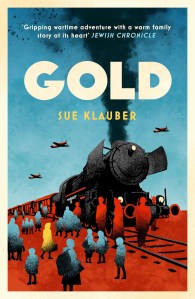
“Back from North Africa, John is part of an intelligence organization based at Trent Park House tasked with handling captured German officers and recording their private conversations. Will their secrets help the Allies as they prepare to invade France? While in German occupied Hungary, George liaises with resistance groups. Can he track down their sister Eva? And help her escape from the Nazis? They must succeed, both for Britain, their adopted country and for the survival of their Jewish family itself.”
Growing a series: how the tone of the novels grew as the protagonists grew older
The protagonists in Zinc, Cobalt and Gold are both young adults in one plot, as they play their parts in World War Two, and children in the parallel plot as they remember the adventures and relationships with each other which turn into their abilities and challenges in the war. They have to resolve their conflicts with each other on their journeys to become who they really want to be.
The trilogy – and you don’t have to have read Zinc and Cobalt to understand Gold – spans 1938, the year before the start of the war, until it ends in 1945. As such John, George, and Eva, who are based on my father, my uncle, and my aunt, get older and more experienced as they move from one country to another, wherever the roles they are required to play in the war take them. John goes to Egypt in Cobalt, as Bletchley Park, the centre for breaking German codes in Britain, created mobile units that could join the generals on the battlefields. George, who is in Special Operations Executive (known as SOE), travels to Slovakia, Poland and Hungary over the course of the series and learns more about himself during his missions. Eva stays in Hungary in great danger as a Jewish woman, fighting back however she can. In the parallel plot they go from running around on holiday in Zinc, when John was just four years old and his siblings some years older, and then they move to secondary school in Cobalt and Gold.
The main thing that changes however is the way that the persecution of Jewish people, the Holocaust, is introduced and developed throughout the series. Zinc is aimed at keen Year 6 readers into Year 7 and 8. Cobalt is more Years 8 and 9 as it is more explicit about the brutality. It is harder-hitting and therefore darker and Gold is more explicit still. I was sensitive to the age of readers and I wanted to introduce the subject gradually.
In the parallel plot of Gold, the trio encounter the British Union of Fascists and its leader, Oswald Mosley and this acts as a warning that prejudice and antisemitism can grow nearer to home and we must always be alert to it and do all we can to fight it in the way that the siblings do.
A timely warning, then, for us all to be aware of prejudice as it appears around us and to be mindful of how we can fight it. We need to learn from history if it is not to repeat itself.
Jo.
*Thank you to Troika Books for inviting me to be a part of this blog tour*